Solutions Now Africa
No Result
View All Result
Saturday, June 13, 2026
  • Home
  • Headlines
  • Quickies
  • Community Solutions
    • Climate Change
    • People Fixing Society
  • Changing Narratives
  • Fellowship
Subscribe
Solutions Now Africa
  • Home
  • Headlines
  • Quickies
  • Community Solutions
    • Climate Change
    • People Fixing Society
  • Changing Narratives
  • Fellowship
No Result
View All Result
Solutions Now Africa
No Result
View All Result
Home Community Solutions

Young Ugandans With Special Needs Lead The Making of Inclusive Communities

Rhonet Atwiine by Rhonet Atwiine
2024/03/27
in Community Solutions, People Fixing Society
Reading Time: 5 mins read
Young Ugandans With Special Needs Lead The Making of Inclusive Communities

Beauty for Inclusion:

Young Ugandan With Special Needs Lead Communities on Inclusion

Written by: Rhonet Atwiine

Elijah  Arinaitwe’s world is that of a constant battle with an unrelenting enemy: the rays of the sun. Everyday, he must take extra precaution to wear protective clothing, sunscreen and precaution to avoid any form of exposure. 

The 24-year-old lives with albinism. He was born into a family of four children, and growing up as a person with unique features at home and community was a tough job.  

“Looking at myself in the mirror, the reality struck me: my skin color was unchangeable. At that moment, I found no alternative but to embrace myself just as I am,” he reflects.

However, he has learned to confront this segregation, and is leading sensitization efforts for the safety of people living with albinism in his community of Namasuba outside Kampala, all thanks to a model being pioneered by a non-profit organization which is using beauty to challenge stigma. 

Unique Abilities Foundation Africa (UAFA) a non-profit organization formed by persons with disability for people with disability is empowering differently abled young men and women in the country to lead efforts on equality in the communities where they live.  

Since 2020, the charity has been  moving to the four regions of the country mobilizing young people with special needs including‌; visually impaired, the hard of hearing, Albinism, Vitiligo, Cerebral palsy, physical disability, and Autism to compete in a beauty pageant

Some 5000 young people have taken part.  According to Saad Ngabo, the Public Relations Officer at UAFA, the purpose of the model is to create a platform where they are included and celebrated.

“We realized that in other beauty pageants, there are beauty standards and people think to be beautiful, you must present a certain level of perfection. If you have a flaw, for example, if you’re visually impaired, you’re considered imperfect. So that means you can not compete with others,” Ngabo says. 

Arinaitwe has participated in the pageant and was crowned Mister Ability 2022. 

“I had the zeal to prove to people that I am also a human being …it was my time to shine,” he says.

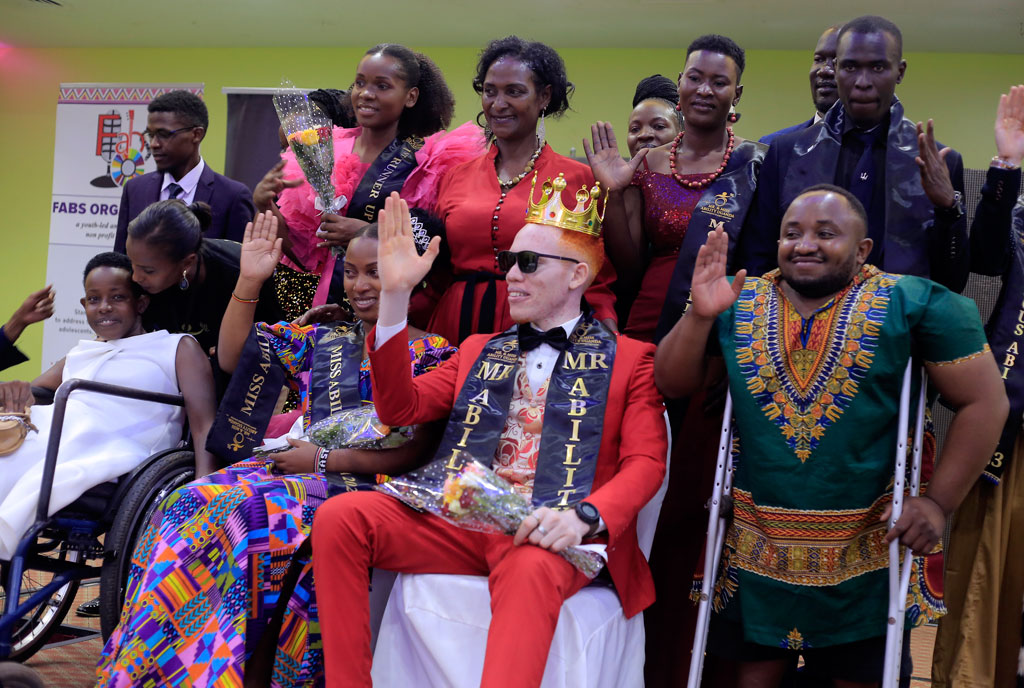
Elijah Arinaitwe (with a crown) pictured with other contestants in Kampala. Courtesy photo.

People with albinism in Uganda are socially profiled as “Namagoye ” which itself embodies stigma. On top of this, they are prone to multiple human rights violations including mutilation, and harmful practices related to witchcraft accusations and ritual attacks.

Yet according to the Uganda Bureau of Statistics (UBOS) 12.4%  of the country’s 47 million population live with some form of disability.  

Whereas the country has in place relevant laws and framework to protect people with special needs, they are short of translating into tangible social dividends that create equality and opportunity for people living with disability. 

Stigma and discrimination is a common experience for persons living with special needs, according to Easter Kyozira, the Chief Executive Officer of the National Union of Disabled Persons of Uganda (NUDIPU).  

“Our communities isolate people with disabilities. This unnecessarily creates a discriminating environment which is unfair. And this is due to lack of awareness on the rights of people living with disabilities.” Kyozira says

Stigmatizing attitudes extend to crucial areas such as education, hospitals, among other public spaces hinder PWDs from accessing crucial life interventions.

Kyozira calls for the need to break the cycle of discrimination and ensure that everyone, regardless of their abilities, has equal opportunities. 

The young people like Arinaitwe who have taken part in this pageant are not stoping at taking leadership in inclusion but crucial community advocacy in areas like Sexual Reproductive Health and Rights (SRHR), and digital literacy, among others. 

The organization also runs a leadership fellowship where upon every year, contestants are taken through a two-week boot camp designed to empower PWDs. 

“When I entered the room where everyone had a disability, I felt at home. I was sure about the fairness in the pageant because we were almost similar.” Arinaitwe notes.

During the fellowship, efforts are focused on cultural identity, boosting self-confidence, tackling community-driven stigma, increasing awareness of the rights of people with special needs, and fostering enhanced entrepreneurial skills.

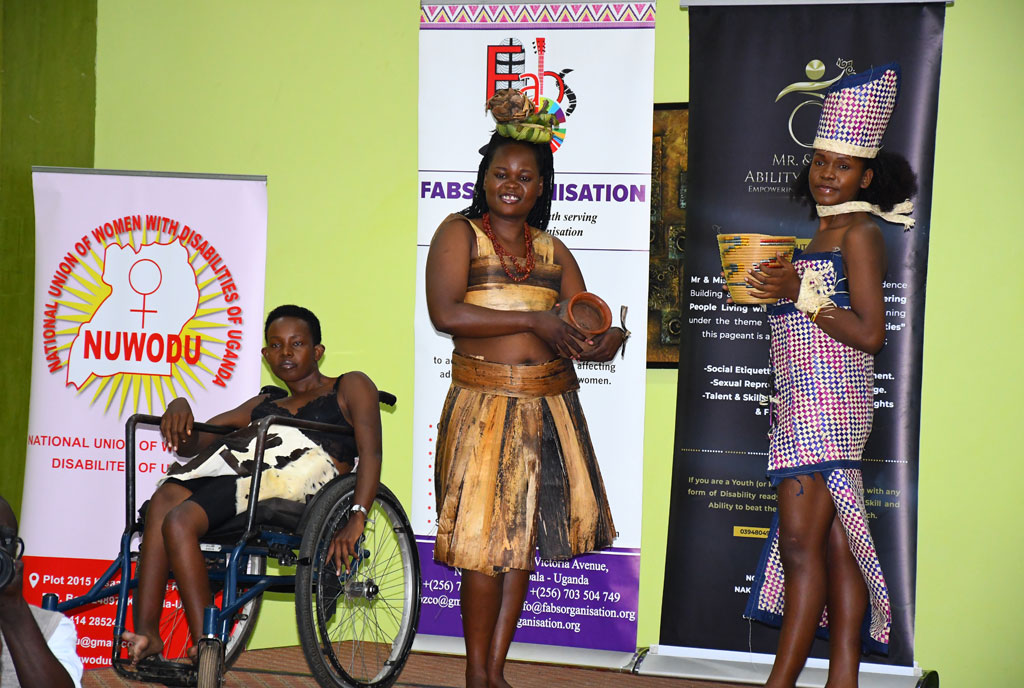
A contestant in a wheel chair seen during a beauty contest. Courtesy photo. 

“We ensure that when they go back to their communities, they can share the knowledge acquired but also focus on the solution. As an organization, our role is to identify potential funders who can fund the project so that more young people with disabilities can benefit,” says Ngabo.

After the competitions, those who emerge winners are also turned into ambassadors of change and community advocates. 

They are assigned to partake in various activities, including participating in community dialogues and engaging in national events such as the International Day of Disabilities, both at local and national levels.

As a prominent figure now, Arinaitwe is focusing on fashion as a tool for inclusivity and diversity.

“I train PWD to model and dance at a zero cost. When they perfect such talents, they can earn thereafter,” Arinaitwe says.

Despite the necessity for these pageants, there are obstacles that impede their aim to combat stigma.

According to Ngabo, there is pushback from parents who reject their children from participating in the pageant due to the “public embarrassment” that comes with having a child with a disability that contributes to the reducing number of participants.

Despite the ongoing challenges, the team is dedicated to taking this to the next level in East African countries and later to the entire world.

Recent News

How Climate Smart Farming is Changing Farmers Prospects in Northern Uganda

How Climate Smart Farming is Changing Farmers Prospects in Northern Uganda

December 16, 2025
Sowing Despair: How Dry Spells are Sending Mothers Into Depression

How Farmers are Collaborating to Manage Unpredictable Climate

December 16, 2025
Solutions Now Africa

We are Africa's first solution journalism newsroom producing immersive stories on innovations, models and systems that are working around Africa. We also work to produce alternative solutions stories to challenge negative narratives about the continent.

© 2022 - Media Challenge Initiative | All Rights Reserved .

No Result
View All Result
  • Home
  • Headlines
  • Quickies
  • Community Solutions
    • Climate Change
    • People Fixing Society
  • Changing Narratives
  • Fellowship

© 2022 - Media Challenge Initiative | All Rights Reserved .