Rewriting Progress:
Patients Fear for Worse After HIV Support Cut
Written by: Abisagi Nalwadda
It is about 10:00 a.m, and Rose Sanyu, a community health worker in Kisalosalo cell in Kampala’s informal settlements of Kamwokya is already overwhelmed by frantic calls from her patients.
Sanyu is part of the Village Health Team (VHT), who are a community-based volunteer team that serve as the first point of health service delivery in Uganda’s health structure.
She has been leading on HIV treatment by ensuring a constant supply and adherence to lifesaving antiretroviral (ARV) drugs to people living with the disease.
But today, her routine is overshadowed by a growing crisis. The supplies are dwindling and patients are desperate.
“Some patients no longer wait for me to call. They struggle to get medicine because of a severe drug shortage we are facing,” she says.
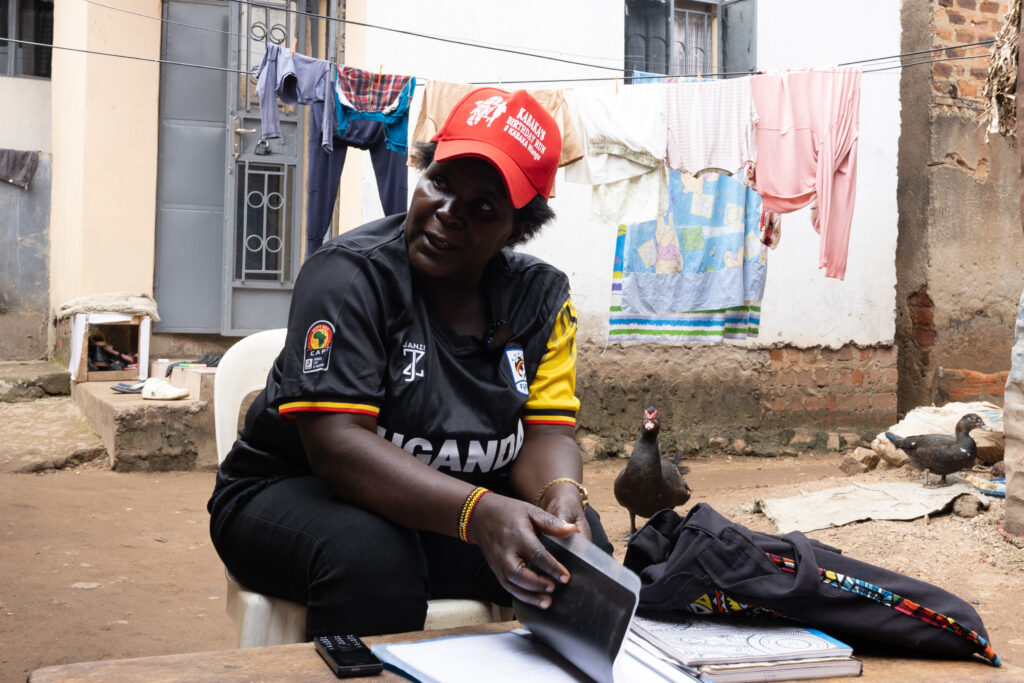
Village Health Team member Rose Sanyu uses expired drugs to demonstrate to a patient how to keep their drugs safe. The absence of patient care has affected drug usage procedures. Photo by George Mukisa.
For the longest time, most HIV patients have relied on Kamwokya Community Center—church-base community charity that runs serial empowerment programs including healthcare services—for HIV counseling and care.
One such patient is Zinah Nabbosa, who has been on Sanyu’s case lately.
“I reached out to a community center for my medicine but they told me I have to pay 5,000 shillings and I don’t have that money.” She added, “I have no medicine left for me, my kids,” she adds.
Also part of Nabossa’s pain is that she is yet to receive the routine ration, which is usually a combination of soya flour and milk powder to supplement her nutritional needs during treatment.
The community center’s HIV/Aids campaign had been directly funded by the US’s President’s Emergency Plan for AIDS Relief (PEPFAR) through the United States Agency for International Development (USAID). Since the Agency closed its operations, the center has been struggling.
According to Francis Mbaziira, Executive Director of Kamwokya Christian Caring Community (KCCC), the charity that runs the center, the current support received can no longer meet the pressure.
“We’ve been dealing with the spread of HIV in an integrated way offering care, support and treatment to those in need … what has changed is that the support has reduced but the number of people coming for treatment remains high,” Mbaziira says.
Zaina Nabosa, a resident of Kamwokya shares how the funding gap has affected patients who depend on Kamwokya Community Center for Support. Photo by George Mukisa.
The charity now is struggling to meet its utilities on which patients depend and also, it has to deal with staffing issues after it laid off workers when the support was cut.
“The costs are going up for electricity, transport and we haven’t increased staff pay as we used to. We only have two doctors now because we can’t afford to hire more. Eight nurses are serving over 30,000 people with only four nurses working in the community,” he explained.
This is prompting the charity to charge a subsidized cost on patients for its services in order to meet its shortfalls.
“We’ve even had to ask patients for help … when they come here for services we can’t give them free treatment anymore,” he says.
Despite these difficulties, Mbaziira remains committed. “We are doing our best to serve the community but the challenges are growing,” he said. “We need more support to continue helping those affected by HIV/AIDS.”
VHT leader Rose Sanyu during a patient visit. Photo by George Mukisa.
Kamwokya, like many informal and low-resource urban communities in Uganda, are synonymous with high HIV rates. This is mainly because of limited economic opportunitie which prompts risky behavior like commercial sex work, alcohol and substance abuse, and higher rates of sexual violence.
These create a cycle of vulnerability that facilitates the spread of the virus.
About 1.4 million adults and children are living with HIV. Yet more than 80% of those living with HIV had been receiving antiretroviral (ARV) medications before the aid cut.
Kampala has an HIV prevalence of 6.9%, which is higher than the national average for adults aged 15-49. The rate is higher among females compared to males.
Uganda’s HIV infection fight has largely depended on the US funding and ever since the cut, it has left the country in disarray.
According to a recent instruction from the Ministry of Health, the country is shifting HIV/AIDS and TB care from dedicated clinics to government general healthcare services, integrating them with other chronic disease services.
The government is also reallocating domestic funds, including UGX 6 billion for electronic medical records, and seeking other international collaborations and private sector solutions.
Uganda’s HIV and Aids care has been beyond the treatment. The national holistic approach includes sensitization to prevent new cases, fighting stigma among other thing. All these have depended on USAID.
The US funding for stigma, discrimination, and enabling legal environments has stopped, and no alternative funding has been found. Communities are not collecting data on human rights issues, including increased stigma and discrimination, according to UNAids.
Organizations like the Uganda Network of Young People Living with HIV have been hit hard by the freezing of US aid funds.
According to Derrick Mbalya, Public Relations Officer of the Uganda Network of Young People Living with HIV, organizing beauty pageants for youths fighting stigma commonly known as “Y+ Beauty Pageant” says these contests have empowered many young people across Uganda. “It has enabled many to become leaders and policymakers in their communities,” he said.
Derrick also noted that the loss of US aid has affected these contestants and the organization.
“US aid has been a key partner providing media coverage, logistics and support for regional activities. Without this support, media coverage has been limited and turnout from communities is low. We are now looking for other supporters,” he explained. He added that in previous years, USaid and PEPFAR were the biggest supporters not only financially but also through manpower.
Regarding the timing of the events, Mbalya said they have been impacted by delays. “We usually start in September, with regional tours in October. But now, it’s October and we are just beginning pre-programming,” he said.
Discussing the role of government, Derrick said local governments help in mobilizing communities by providing venues and connecting them to district officials. “Local governments link us to district officials and health focal persons at the district level,” he explained.
Mbalya emphasized that the government has been endorsing these pageants and connecting them to partners, although it does not support them directly.
He said the pageants aim to end HIV and stigma by 2030, aligning with the goals of the Ministry of Health and Uganda AIDS Commission.
These create a cycle of vulnerability that facilitates the spread of the virus.
Also, key populations groups have conducted a rapid assessment on the impact of the US funding cuts. There is also ongoing work to conduct an assessment with people living with HIV and key populations-related services at drop-in centres.
However, dependence on an already struggling health infrastructure for HIV treatment and care is a risk in itself.

On the ground, Nabbosa emphasizes that the government “needs to accelerate the services because we are suffering and many like me are losing hope,” she explained. “I’ve spent three months not taking drugs regularly and this pushed me to start drinking alcohol,” she says.
Also, the Ministry is yet to fully implement the shift. According to Sanyu, the situation in her community is getting worse because “people can no longer afford to access these drugs because the supply is low. You might go with ten people and they all need medication but there’s little or no medicine available,” she says.
Patients are asked for money they don’t have and sometimes they are turned away or asked to seek help elsewhere.” She also lamented the scarcity of life saving drugs for those living with HIV: “We can’t get LTD drugs for patients who need them immediately. When supplies are limited people share tablets or get only a few, which is dangerous.”
“We got so shocked when they said they’ve frozen the funds. Kamwokya is highly populated and it’s hard to avoid contracting HIV/AIDS in such a community.” Sanyu explained how in previous years residents could access free drugs and health services with ease but now that is no longer the case.